
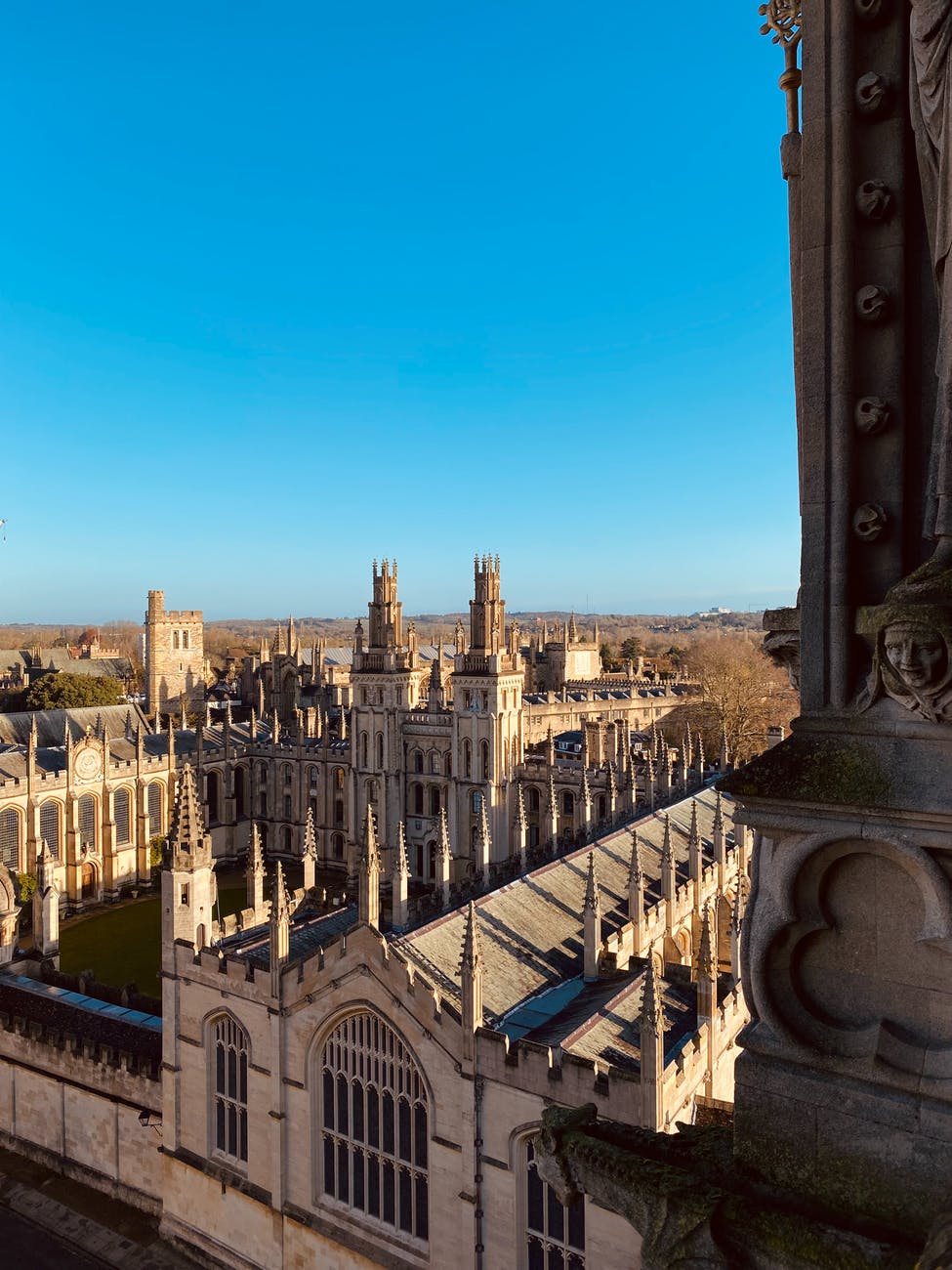
It has been a long time since my last blog post, so for those of you who are signed up to the mailing list I thank you for your continued support, and to those of you who have just joined then welcome! As we all know, 2020 was a very trying year, but I am determined to start afresh this new year and bring you some long awaited content to keep you informed and entertained this lockdown. So without further ado, here is History for Lockdown 2021.
As you know, I am a London Tour Guide and I am really looking forward to delving deeper into the many boroughs London has. Today, however, I have decided to travel up the M40 to Oxford. Not literally of course. I made the decision to do this because of the recent approval and roll out of the new Oxford/AstraZeneca vaccine. I think it is only fitting to write about the university, where it all started and how it has led to creating the second Covid-19 vaccine to be approved in the UK.
The University of Oxford is always held in very high esteem, and for good reason. Oxford is the oldest university in the English-speaking world and is one of the most prestigious academic institutions. Despite the university having no known foundation date, there is evidence that Oxford has been a place of teaching and learning since as early as 1096. The student body grew in number rapidly after Henry II banned English students from studying at the University of Paris in 1167. During 1209 there were disputes between the townsfolk of Oxford and the scholars. To avoid being embroiled in the violence some scholars fled to Cambridge, thus establishing the university there. These two ancient universities share many similarities and are often together known as “Oxbridge”.
Students at the university would associate together on the basis of where they were from and were split into “nations” that represented the North (including those from north of the River Trent in England and those from Scotland) and the South (including those from south of the Trent, those from Ireland and from Wales). Much later, centuries later, where you were from often influenced which college or hall you would become a member of. As well as this many religious orders such as the Dominicans, Augustinians and Franciscans settled in Oxford in the mid 13th century and maintained the colleges and halls for the students. Alongside this there were private benefactors who established and founded colleges that became communities for the students and scholars who lived there.
The earliest colleges founded were University College, founded by William of Durham in 1249 and Balliol College, founded in 1263 by John I de Balliol. Balliol College is not only one of the oldest colleges in the English-speaking world, but the oldest college to be co-founded by a woman. Following the death of de Balliol in 1268, his widow, Dervorguilla of Galloway, ensured the permanence of the college by providing the necessary funds. Merton College was founded in 1264 by Walter de Merton, a former Lord Chancellor and the Bishop of Rochester. Merton College became the model for the college life we would be familiar with today. Rather than students living in halls or in religious accommodation, the colleges were now communities in which students would live and study. All three of these colleges claim to be the oldest, and there are compelling arguments for each. I invite you to dig out some of these and see which argument wins it for you!
The 16th century brought with it the English Reformation and the split from the Roman Catholic Church. The scholars who refused to convert to the Anglican Church fled to Europe and the method of teaching at Oxford changed from the medieval scholastic approach to Renaissance education, marking the new age of modernity. During this time the university’s reputation for teaching and learning declined. The Age of Enlightenment brought less students to study and teaching was neglected. From the start of the reformation until 1866, it was a requirement when enrolling to be a member of the Anglican Church in order to receive the BA degree and those who objected to this church or belonged to another were only allowed to receive an MA from 1871.
During the English Civil War, the university was a centre for the Royalist party and became the headquarters for the King’s troops. The city, however, was sympathetic to the Parliamentarian cause. A military campaign against the Royalist party who was controlling the city of Oxford was waged and there were three short engagements over a 25-month period. This is known as the Siege of Oxford. The first engagement took place in May 1644 in which there was a plan to capture Oxford and the King, however this was unsuccessful. Charles I managed to escape in the night and therefore prevented the Parliamentarian side to siege. The second engagement was in May 1645 and as soon as it had begun, Sir Thomas Fairfax, the Parliamentary Commander in Chief, was given orders to stop and follow the King to Naseby. The last siege was in May 1646 and lasted two months. However at this point the war was already over and so rather than fighting, negotiations began. Given that neither sides wanted to see Oxford too damaged, Sir Thomas Fairfax stopped the siege without any further escalation.
In the 1650s, Wadham College became the undergraduate home of Sir Christopher Wren, celebrated architect who had the mammoth task of rebuilding the City of London (including St Paul’s Cathedral) following the Great Fire of London.
It wasn’t until 1875 that the university passed a statute allowing examinations for women. In 1878 the Association for the Education of Women was formed and set to work on campaigning for the creation of a women’s college. The members of the association did not entirely agree on how to proceed, for instance Edward Stuart Talbot, a successful Anglican bishop, insisted that the new college should be an exclusively Anglican institution, however his colleague in the association, T.H.Green, disagreed. They ended up splitting from the association and Talbot founded Lady Margaret’s Hall in 1878 and Green founded Somerville College (a non denominational college) in 1879. Women who joined the colleges began attending lectures above an Oxford baker’s shop. A further 25 students were living at home, a group that turned into the Society of Oxford Home Students and in 1952 it evolved into St Anne’s College.
These were followed by St Hugh’s, St Hilda’s and all became coeducational starting with Lady Margaret’s Hall and St Anne’s in 1979. St Hilda’s was the final college to become coeducational, accepting its first male students in 2008. Oxford has, and to an extent still does, bare the perception that it is an institution sticking to the idea of male privilege. Particularly white male privilege. The First World War helped to adjust that idea with the integration of women pushing ever forward. In 1916 women were accepted as medical students on the same level as men, and in 1917 the university accepted responsibility to pay women’s exam fees. It was in 1920 that women were given the right to actually earn their degrees. Up until this point they were allowed to do all the study, some finishing top of their class, but not allowed to receive their formal qualification. A fact that makes the modern woman of 2021’s head explode. From the 1970’s onwards the previously all male college began to accept female students, and it was in 2016 that it was recorded that 47% of undergraduate students were female.
Today, Oxford is one of the leading research universities with the medical school taking first place in the “Clinical, Pre-Clinical and Health” table in the Time’s Higher Education World University Rankings for the last seven years running. Oxford has been the place of study for many famous scientists including Nobel Prize winner Dorothy Hodgkin, Stephen Hawking and Edwin Hubble. The university is associated with eleven winners of the Nobel Prize in Chemistry, five in Physics and sixteen in Medicine. It doesn’t take an Oxford genius to see why the Covid-19 vaccine was so quickly produced!
I hope you have enjoyed my history of the University of Oxford. Next time I will be back in London (although I physically haven’t left in months) enlightening you with more History for Lockdown!
 Gilbert Tours