
Hello everyone. I’ve been a little quiet of late as the Gilbert Household has been a little under the weather! But we are back to feeling ourselves again so I thought it about time I wrote a little something.
Now we are all staying indoors to help stop the spread of this awful virus, as a tour guide I cannot be out there doing my job so I thought I’d bring the history to you! Maybe you’ll find some of these places within reach of your homes so you can add them in to your daily exercise outing. Or you can sit back, relax and enjoy reading about them from the safety of your homes.
So where to start? I live in South East London, specifically Downham which is on the cusp of the Lewisham/Bromley boroughs. We fall into the Lewisham bracket (Lewisham is another story) and we are slap-bang in the middle of Catford and Bromley town. We have lived here for just over 7 years and it wasn’t until recently that I started exploring the history of the area.
Bromley itself was the first big town before reaching London that travellers from Kent, Sussex and other parts of the South East of England would stop at. The Bell Hotel would accommodate those on their way to and from the city. In fact, Lady Catherine de Bourgh in Jane Austen’s Pride and Prejudice mentions it to Elizabeth Bennett; “Where shall you change horses? Oh! Bromley, of course. If you mention my name at the Bell, you will be attended to.” (Austen, 1813.) Originally the Bell Hotel, located just North of Bromley Market Square, was a 1666 hostelry but by 1890 the front was falling down and was rebuilt in 1898 along with the rest of the High Street that you can see a lot of today. Jane Austen travelled often from Hampshire to visit her brother in Kent and would most certainly have stopped in Bromley.
But we must start at the beginning. The Romans built a camp at Keston where there is a natural spring, known as Caesar’s Well and is the source of the Ravensbourne. After the Romans left, the Anglo-Saxons built a settlement a few miles away and developed it where today you would find the market square. The name “Bromley” was first recorded in 862 AD as “Bromleag” which means “the place where broom grows” in Anglo-Saxon.
In the 10th century, Bromley was chosen by the Bishops of Rochester to be their base for visitors to London. The most recent Bishop’s Palace, built in 1775 surrounded by a moat, is now part of the Bromley Civic Centre. It took me a long time to find this as it is very well hidden behind the shopping centre’s overflow multi-storey car park. The last Bishop to live here left in 1845. If you know Bromley well, you have most likely seen the oldest building in the town without even realising. Just opposite the Bromley Magistrate’s Court stands the town’s almshouses. A beautiful red brick building called the Bromley and Sheppard’s Colleges. It was founded and built in 1666 by the then Bishop of Rochester John Warner, to provide housing for “twenty poore widowes of orthodoxe and loyall clergiemen.” This particular bishop had been deprived of his beautiful palace and spent his time travelling the West Country staying with different friends and relatives. 17th Century sofa-surfing at its best. Because of this he knew what it was like to be homeless and so used his considerable wealth to provide for the widows of the clergy whose husbands had been killed in the Civil War (while supporting the King of course) just a decade or so before.
It had been intended that the college be built in Rochester but the land was not available. Instead they found land near the Bishop’s Palace in Bromley and built it there. Later, in the 18th Century another Bishop of Rochester (there have been a few, bear with me) had the building extended and added what is known as the “New Quad” and made the chapel larger for the growing number of residents. In 1840, on the same site, Sheppard’s College was then founded for unmarried daughters who had resided in Bromley College with their widowed mothers but were then left homeless when their mothers died. It was named Sheppard’s College after Mrs Sophia Sheppard, widow of Dr Thomas Sheppard who was President of Magdalen College, Oxford. Bromley and Sheppard’s Colleges have always had a close affiliation with Magdelen College, Oxford as Bishop Warner (the man who started this whole tangent and the Bishop I mentioned originally) was a fellow there, as were the early chaplains. The chapel was rebuilt in 1862 to accommodate an even larger number of residents after the opening of Sheppard’s College and the beautiful Victorian stained glass window depicts women from the Bible. It is really a wonderful building to look at, and when not in Coronavirus Lockdown you can arrange to visit. To this day the colleges’s residents are still widows and daughters of the clergy together with retired clergy and their spouses.
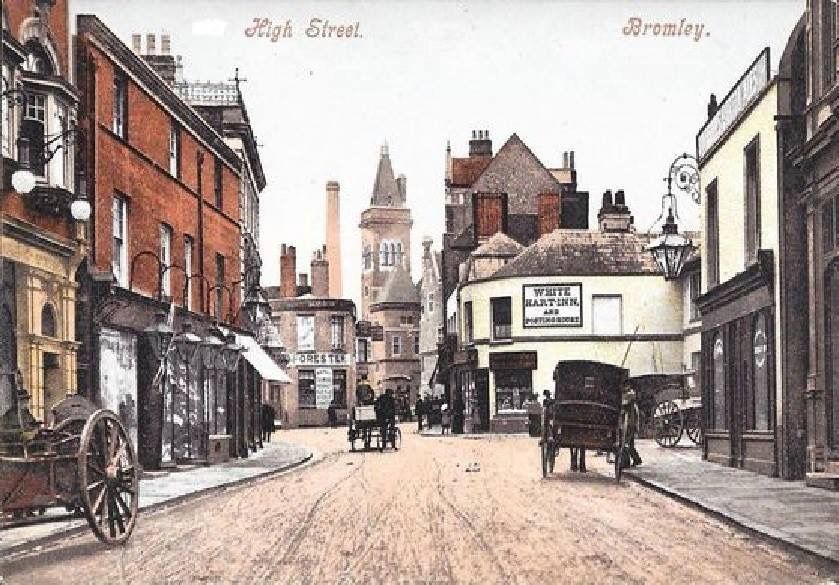
The growth of the railway made the northern part of Bromley borough a place for London visitors to stay, or city workers to reside. The southern area still remains mostly countryside. Several literary greats lived in Bromley town, most notably H.G.Wells, author of such works as “The War of the Worlds” and “The Time Machine”. You can find where he went to school on South Street, although the building he would have known was rebuilt some years after his departure. You can also find his birthplace which is located where Primark now stands. During WWII Bromley was badly damaged. The Market Square and the pedestrianised part of the High Street for instance is now mostly unrecognisable to the original. (See the picture at the top of the page.)
Bromley borough is a thriving part of South East London but in the time of Queen Victoria it was a leafy town outside of the city. Prince Albert, husband of Queen Victoria, came up with the scheme of The Great Exhibition, a steel-and-glass palatial exhibition hall that was built in Hyde Park in 1851 and open from May until October that same year. It was visited by six million people during that time. In 1854 it was relocated in enlarged form to a green open space in Penge now known as Crystal Palace (an obvious choice of name now you think of it). However, in 1936 an enormous fire destroyed the building and now only a few columns and walls can be found in Crystal Palace Park. Perhaps you could look for what remnants you can find while walking there.
Here is where I end this brief history of some parts of the Bromley borough. Even if you think you live somewhere new and fairly recently built, the land underneath you holds stories going back thousands of years. Next time, I will be moving further towards the city and will concentrate on the boroughs of Lewisham and Southwark which will include Downham, Dulwich and Peckham. I hope you enjoyed this instalment and I look forward to delving into your local history in the coming weeks. Until then, take care and stay safe.
 Gilbert Tours